
In today’s business environment, efficiency has become a dominant priority. Processes are automated. Presentations are standardized. Frameworks are replicated across markets and industries. Even strategic recommendations are increasingly generated through templates designed to accelerate delivery and maximize scale.
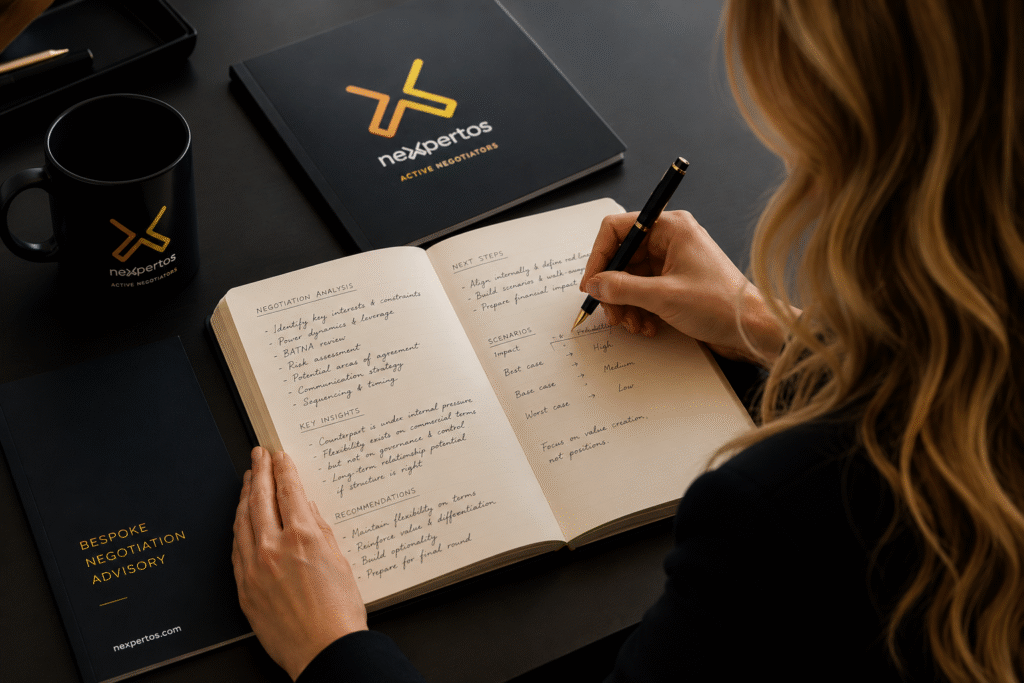
From an operational perspective, this makes sense. But negotiation is not operations.
And one of the biggest risks companies face today is treating negotiation as if it were a repeatable industrial process rather than a human, strategic and highly contextual discipline.
At neXpertos, we often observe the same paradox inside organizations: the larger and more sophisticated the company becomes, the greater the pressure to standardize decision-making.
Yet the most critical negotiations rarely fit inside standardized models.
Negotiation does not happen in theory. Instead, it unfolds between people, often under pressure, uncertainty and shifting dynamics.
And that is precisely why bespoke negotiation support still matters.
Negotiation Is Not “Prêt-à-Porter”
Many consulting models today are built for scalability.
Large volumes.
Reusable frameworks.
Replicable methodologies.
Standardized diagnostics.
Automated reporting.
There is nothing inherently wrong with this approach — for certain business needs.
But when negotiations directly impact profitability, strategic positioning, partnerships or long-term commercial relationships, companies often require something very different.
They require interpretation. Judgment. Adaptability. Contextual thinking.
In other words, they require work that cannot simply be copied and pasted from one situation into another.
At neXpertos, we do not approach negotiation as a catalogue product.
We believe every negotiation has its own architecture:
its own emotional climate,
its own power structure,
its own invisible tensions,
its own decision-making rhythm.
Even when two negotiations appear commercially similar on paper, the human dynamics behind them are often completely different.
And those differences matter.
Because in negotiation, small details frequently produce disproportionate consequences.
The Danger of Generic Advice
One of the hidden dangers of standardized consulting is the illusion of applicability.
A recommendation may sound intelligent.
A framework may appear sophisticated.
A report may be visually impressive.
But if the analysis has not been deeply adapted to the specific negotiation environment, its practical value may be extremely limited.
This happens more often than companies realize. Especially in high-pressure commercial environments where teams are looking for fast answers.
Under pressure, generic advice feels reassuring because it creates a sense of structure. However, negotiation is rarely solved through formulas alone.
For example:
- A concession strategy that works effectively in one market may weaken positioning in another.
- A communication style perceived as collaborative in one culture may be interpreted as fragile in another.
- A pricing discussion may not actually be about pricing at all, but about power, recognition or internal politics.
Without understanding the full context, recommendations risk becoming technically correct but strategically ineffective.
And in negotiation, that gap can be extremely costly.
Why Human Interpretation Still Matters
Technology is transforming business at extraordinary speed.
Artificial intelligence, automation and data analysis are already improving productivity across countless industries — including consulting.
And they will continue to do so.
But negotiation remains deeply human.

Not because data is irrelevant.
On the contrary, preparation and information are critical.
The limitation is elsewhere.
The real challenge is interpretation.
Understanding:
- what is being said,
- what is intentionally not being said,
- what pressures exist behind the visible conversation,
- how emotions are affecting decision-making,
- and how power is truly moving throughout the process.
These elements rarely appear clearly inside spreadsheets or standardized reports.
They emerge through experience.
Observation.
Pattern recognition.
And strategic judgment developed over years of real negotiations.
This is one of the reasons why, at neXpertos, many of our reports and recommendations continue to be developed manually.
Not because we reject technology.
But because we refuse to replace strategic thinking with industrialized output.
In complex negotiations, nuance matters.
And nuance requires attention.
The False Efficiency of Copy-Paste Consulting
There is another important issue that organizations rarely discuss openly:
speed can create the illusion of effectiveness.
Receiving a report quickly feels efficient.
Receiving a standardized framework feels scalable.
Receiving polished slides creates a perception of professionalism.
But negotiation outcomes are not determined by the elegance of the presentation. They are determined by what happens at the table.
And that requires much deeper work.
Sometimes it means challenging assumptions that the client initially considered correct.
Sometimes it means identifying internal contradictions inside the organization itself.
Sometimes it means recognizing that the real negotiation problem is not external, but internal alignment.
This level of analysis cannot emerge from recycled recommendations.
It requires time.
Listening.
Critical thinking.
And often uncomfortable honesty.
Bespoke negotiation advisory is demanding precisely because it forces consultants to think from zero each time.
There is no safe shortcut. No automatic answer. No universal script.
Only disciplined strategic work adapted to the specific reality of each negotiation.
Negotiation Is Context
One of the biggest misconceptions about negotiation is the belief that success depends primarily on tactics.
In reality, tactics without context are dangerous.
The same behavior can generate completely different results depending on:
- timing,
- counterpart personality,
- organizational pressures,
- cultural expectations,
- market conditions,
- power perception,
- and relationship history.
This is why experienced negotiators rarely rely exclusively on rigid formulas.
They adapt constantly. They observe constantly. They recalibrate constantly.
At neXpertos, we often say that negotiation is a living process, not a scripted performance. And living processes require active thinking. Not mechanical execution.
The Premium Value of Attention
Perhaps the real conversation today is not about technology versus human expertise.
It is about attention.
In a world flooded with automated content, replicated frameworks and accelerated consulting cycles, genuine attention has become increasingly rare.
And increasingly valuable.
When a company receives truly personalized negotiation support, what it is really receiving is focused strategic attention:
- careful analysis,
- contextual understanding,
- intellectual rigor,
- and recommendations specifically designed for its reality.
That level of work is difficult to scale massively.
But it creates something extremely important:
relevance.
And in negotiation, relevance changes outcomes.
Beyond Methodology
Methodologies matter.
Structure matters.
Preparation matters.
But negotiation is ultimately a human discipline.
A discipline where interpretation frequently matters more than information.
Where emotional control often matters more than technical arguments.
And where strategic clarity matters more than speed.
That is why we continue to believe in bespoke negotiation advisory.
Not because it is fashionable.
Not because it sounds premium.
But because in complex negotiations, companies rarely need generic answers.
They need thinking.
Real thinking.
Applied to their specific situation.
Without shortcuts.
Without templates.
Without copy-paste solutions.
Because negotiation is not “prêt-à-porter”.
And the highest-value negotiations rarely deserve standardized advice.
In many ways, bespoke negotiation work also requires something increasingly rare in today’s business world: strategic self-awareness.
This idea is explored further in An Moisson’s article:

